Aral Sea
About Aral Sea
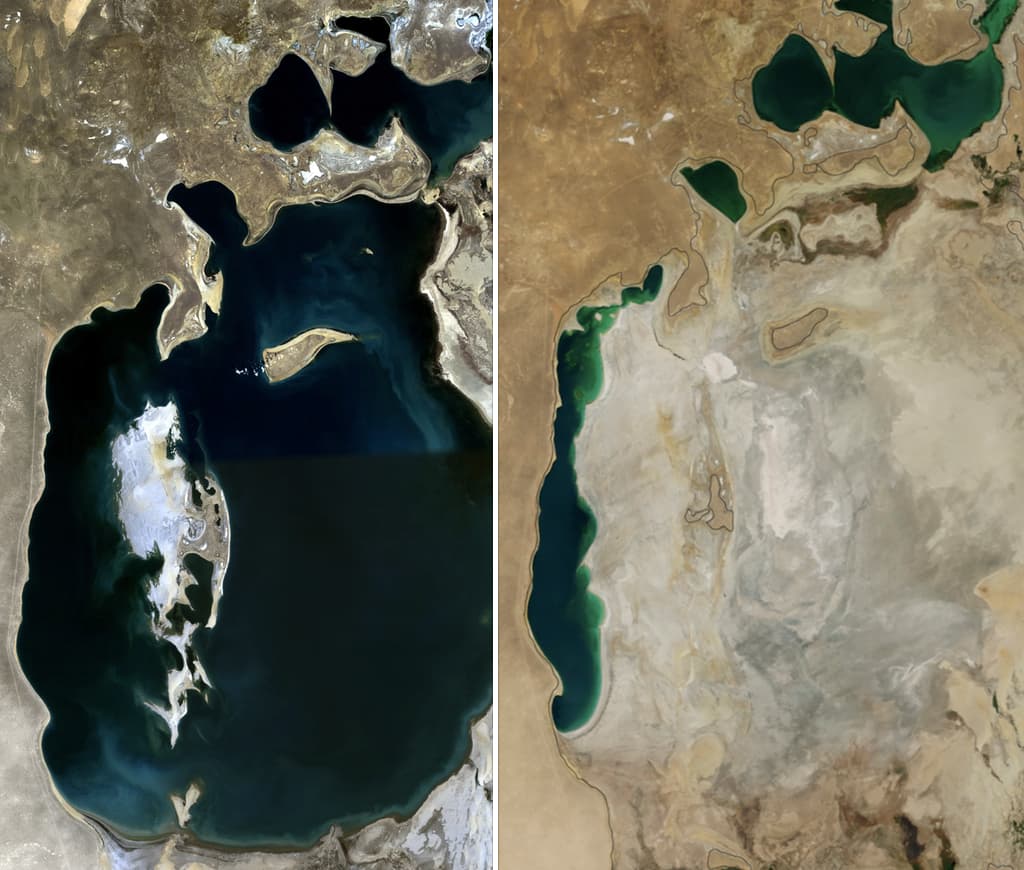
The Aral Sea was an endorheic salt lake lying between Kazakhstan to its north and Uzbekistan to its south, which began shrinking in the 1960s and had largely dried up into desert by 2007. It was in the Aktobe and Kyzylorda regions of Kazakhstan and the Karakalpakstan autonomous region of Uzbekistan. The name roughly translates from Mongolic and Turkic languages to "Sea of Islands", a reference to the large number of islands that once dotted its waters. The Aral Sea drainage basin encompasses Uzbekistan and parts of Afghanistan, Iran, Kazakhstan, Kyrgyzstan, Tajikistan, and Turkmenistan.
On the show · 15 mentions total
The Aral Sea was the world's fourth largest inland sea, so really a lake, and it has now shrivelled to less than 10 percent of its size.
from No Such Thing As Zeno's Harbour · read transcript
More facts about Aral Sea
There is a sea harbour in the town of Moinak in Uzbekistan that is now 150 kilometres from the sea.
516: No Such Thing As Zeno's Harbour · listen
During Soviet times a mega drive to farm cotton in Uzbekistan diverted the rivers feeding the Aral Sea, and cotton is a very thirsty crop.
516: No Such Thing As Zeno's Harbour · listen
The Aral Sea became officially salt water by 1987, and by 1996 it reached the saltiness designation super saline.
No Such Thing As Zeno's Harbour · listen
Now that the Aral Sea is no longer a lake, animals can wander onto an island that was used for chemical weapons testing.
516: No Such Thing As Zeno's Harbour · listen
When the Aral Sea began to deplete, the town of Moinak, which had factories for canning fish, was left stranded away from the coast.
516: No Such Thing As Zeno's Harbour · listen
More places from this episode
516: No Such Thing As Zeno's Harbour put 2 places on the map.
- Colorado River · Mexico
Coordinates: 45.0000, 60.0000